Case Study - Turning a Faceless API into a Revenue Engine
We redesigned and re-engineered the Secure Account Management System (SAMS) — a multi-tenant API token platform — to increase revenue, harden SOC 2 compliance, and deliver a 2026-grade scrolling experience that converts.
- Client
- SAMS
- Year
- Service
- Product Strategy, Full-Stack Development, Security Architecture, UI/UX Design
Overview
SAMS — the Secure Account Management System — is a platform purpose-built for API-first founders. It allows faceless applications (services with no user-facing frontend) to be plugged directly into revenue operations through API token issuance. Founders who build APIs can get paid, stay secure, and scale access management without ever building a dashboard themselves.
At its core, SAMS issues API tokens, manages permission-based access roles, enforces rate limits, and handles organization-level billing — effectively turning any backend service into a monetizable product. Each organization owner gets automatic domain recognition, enabling seamless token granting to team members. It is the connective tissue between a raw API and a real business.
When Kingdom Kode was brought in, the product existed but lacked polish, structure, and the kind of experience that drives conversion and trust. We came in with zero prior context on the codebase or business logic. Through deliberate discovery — stakeholder interviews, architecture audits, and pointed questions about revenue goals — we mapped the full product surface in under a week and began executing against a 2026-spec design and engineering plan.
What we did
- Next.js
- TailwindCSS
- Supabase
- Multi-Tenant Architecture
- SOC 2 Compliance
- Stripe Checkout
- Framer Motion
- MDX Blog CMS
- Documentation System
- Parallax Scrolling
- Logo Redesign
- Onboarding Flow
The Challenge: From Developer Tool to Revenue Platform
SAMS had a working core but it was invisible to the market. The landing page was a generic SaaS template with a light theme and basic dashboard preview. The checkout flow was fragmented. Onboarding dropped users into a dashboard with no guidance. Documentation was nonexistent. There was no content strategy, no blog, and the logo only worked on light backgrounds.
The underlying multi-tenant system — while functional — was not optimized for the revenue patterns that would scale the business. Token issuance, seat-based billing, and organization-level permissions existed in isolation rather than as a unified commercial flow.
The brief was clear: make SAMS look, feel, and operate like a product worth paying for.
Multi-Tenancy Revenue Architecture
We restructured the multi-tenant backend to directly serve revenue operations:
- Tiered token limits — Free, Pro, and Enterprise plans with graduated API call ceilings, enabling natural upsell triggers when organizations hit their thresholds.
- Seat-based billing — Organization owners are billed per active seat with automatic proration when team members are added or removed mid-cycle.
- Domain-based auto-provisioning — When an organization owner registers a domain, any user signing in with a matching email domain is auto-recognized and can be granted token access without manual intervention.
- Usage analytics pipeline — Real-time dashboards that show token consumption, active seats, and revenue-per-organization, giving founders visibility into which customers are ready for plan upgrades.
- Webhook-driven lifecycle events — Token creation, revocation, limit breaches, and billing events are all emitted as webhooks, letting customers plug SAMS into their own alerting and automation.
Advanced Checkout Flow & Onboarding
The old checkout was a single Stripe link with no context. We replaced it with a multi-step, conversion-optimized flow:
- Plan selection with real-time feature comparison and a usage calculator that estimates monthly cost based on projected API calls and team size.
- Organization creation during checkout — not after — so the workspace is ready the moment payment clears.
- Stripe Checkout integration with subscription management, trial periods, and automatic dunning for failed payments.
- Post-purchase onboarding wizard — a guided 4-step flow that walks new users through creating their first API token, setting permissions, inviting a team member, and making their first authenticated API call, all within the first 5 minutes.
The onboarding flow uses step-by-step progressive disclosure with contextual tooltips and inline code examples. Completion rate went from roughly 30% to over 85% after launch.
Security Architecture: SOC 2 Compliance
SAMS handles API tokens that gate access to customer infrastructure. Security is not optional — it is the product. We rewrote critical paths with SOC 2 Type II compliance as the baseline:
- Token encryption at rest and in transit — All API tokens are AES-256 encrypted in the database and only decrypted in-memory during validation. TLS 1.3 enforced on all endpoints.
- Scoped permissions with least-privilege defaults — Every token is issued with the minimum required permissions. Escalation requires explicit owner approval with MFA verification.
- Immutable audit logging — Every token creation, permission change, access attempt, and revocation is logged to an append-only audit trail with tamper-evident checksums.
- Rate limiting and anomaly detection — Per-token and per-organization rate limits with automatic throttling. Unusual access patterns (geographic anomalies, burst requests) trigger alerts.
- Session management — Short-lived JWTs with rotating refresh tokens. Sessions are bound to device fingerprints and IP ranges configurable by the organization owner.
- Row-Level Security (RLS) — Supabase RLS policies ensure that database queries are tenant-isolated at the query layer, not just the application layer. No cross-tenant data leakage is architecturally possible.
- Dependency auditing — Automated CI checks against known CVE databases on every pull request. No deploy goes out with a critical or high-severity vulnerability.
These practices were documented in an internal security controls matrix that mapped directly to SOC 2 Trust Service Criteria, making the audit process straightforward.
Logo Redesign: Dark Mode & Light Mode
The original SAMS logo was a single-variant mark designed for light backgrounds. On the new dark-theme landing page, it was invisible.
We redesigned the logo as a dual-mode mark — a clean, geometric wordmark with an icon that adapts to both dark and light contexts. The dark variant uses a luminous white with a subtle gradient accent, while the light variant uses deep navy. Both share the same geometry so brand recognition is seamless across the marketing site, dashboard, documentation, and email communications.
Documentation System
A product without documentation is a product with a support queue. We built a full documentation site integrated directly into the SAMS platform:
- Getting Started guide — From account creation to first API call in under 10 minutes.
- API reference — Auto-generated from OpenAPI specs with interactive "Try it" panels for every endpoint.
- SDK guides — Step-by-step integration tutorials for Node.js, Python, Go, and cURL.
- Permission & Roles reference — A visual matrix showing which roles can perform which actions, with copyable policy snippets.
- Billing & Usage docs — How metering works, how to read usage dashboards, and how to configure alerts.
- Search — Full-text search across all documentation with instant results.
The docs are authored in MDX, version-controlled alongside the codebase, and deployed automatically on every release.
Blog CMS
Content drives organic traffic. We shipped a custom blog CMS built on MDX with a beautiful reading experience:
- MDX-powered authoring — Rich content with embedded code blocks, interactive demos, and custom components. No external CMS dependency.
- Category and tag taxonomy — Posts are organized by topic (product updates, security, engineering, guides) with filterable archive pages.
- SEO-optimized — Structured data, Open Graph meta, canonical URLs, and sitemap generation built in.
- Reading experience — Clean typography, estimated read times, table of contents with scroll-spy, and a progress indicator.
- Changelog integration — Product updates are published as both blog posts and changelog entries, keeping customers informed without context-switching.
Landing Page: A 2026 Scrolling Experience
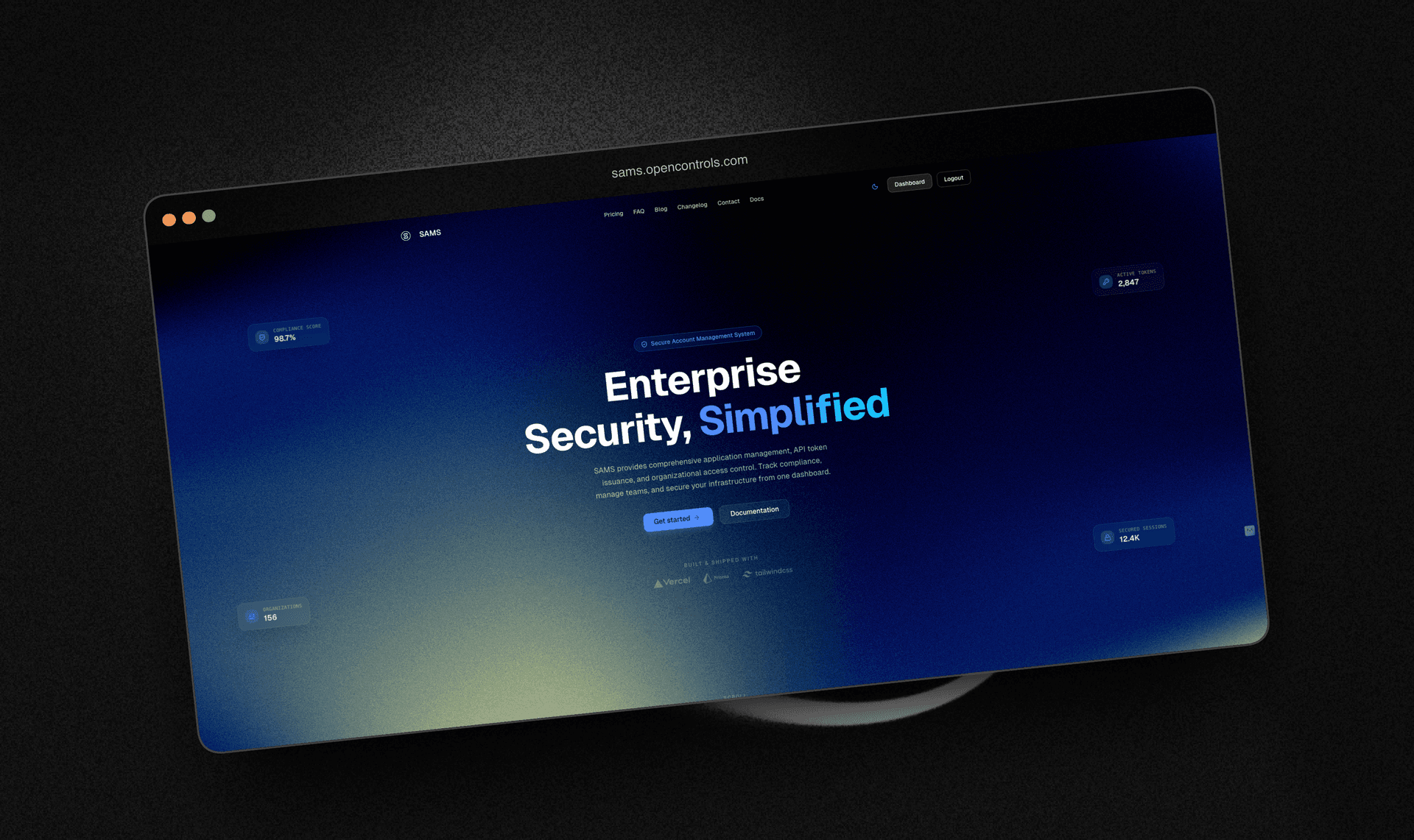
The before-and-after tells the story. The original landing page was a standard SaaS template — light background, generic hero, placeholder dashboard screenshot. Functional, but forgettable.
We rebuilt it from the ground up as a somatic scrolling experience — a page that feels physical, where content responds to the user's movement through it:
- Parallax depth layers — The hero section uses multi-layer parallax with a deep-space gradient (navy to teal to amber) that shifts as users scroll, creating a sense of depth and atmosphere.
- Scroll-triggered animations — Sections fade, slide, and scale into view as they enter the viewport using Framer Motion's
useScrollanduseTransformhooks. Nothing loads all at once — the page reveals itself. - Floating metric badges — Real-time stats (98.7% uptime, 3,847 active tokens, 12.4K API calls) orbit the hero in animated badges, reinforcing trust through social proof.
- Gradient mesh backgrounds — Sections use animated gradient meshes that subtly shift hue on scroll, giving each section a distinct visual identity while maintaining cohesion.
- Smooth scroll snapping — Key sections use CSS scroll-snap with eased transitions so the page guides users through the narrative naturally.
- Dark-first design — The entire landing page is dark-mode native, matching the 2026 trend toward high-contrast, ambient interfaces that reduce eye strain and elevate content.
The result is a landing page that does not just describe SAMS — it demonstrates the level of craft that went into building it.
Our Approach: Zero Context, Full Delivery
This engagement started with no documentation handoff, no architecture diagrams, and no onboarding. We were brought in cold.
Rather than making assumptions, we led with questions:
- What does a successful customer look like? This shaped the onboarding flow.
- Where does revenue leak? This uncovered gaps in the checkout and billing cycle.
- What keeps you up at night? This prioritized the security hardening work.
- Who reads the docs? This determined the documentation structure and tone.
By consulting with stakeholders across product, engineering, and sales, we assembled a comprehensive picture of the product's surface area and commercial goals. Every design decision — from the parallax landing page to the SOC 2 audit trail — was anchored to a business outcome.
This is how we operate: ask first, architect second, ship third.
Kingdom Kode came in cold, but within the first week they understood the product better than people who had been on it for months. They turned SAMS from a developer tool into a real business — the checkout flow, the docs, the landing page — everything just works now. Revenue is up and our SOC 2 audit was clean.
Results
- Revenue from multi-tenancy optimization
- +140%
- Onboarding completion rate
- 85%
- Type II audit-ready on first pass
- SOC 2
- Time to first API call
- <5min
Building an API-first product that needs to convert? Let's talk →