Blog - The latest articles and news
Stay up-to-date with the latest industry news as our marketing teams finds new ways to re-purpose old CSS tricks articles.
Stay up-to-date with the latest industry news as our marketing teams finds new ways to re-purpose old CSS tricks articles.
by Kingdom Kode Team, Digital Innovation

You've got clients who love you. They rebook. They'd recommend you if someone asked. And your new-customer number has been flat for months. If you've been quietly asking yourself how to get more referrals for my business, the answer isn't better service — your service is already good. The problem is you're hoping for referrals instead of engineering them.
Referrals are the cheapest customers you will ever acquire. No ad spend. No cold outreach. They show up already trusting you because someone they trust sent them. And almost every SMB leaves this channel completely to chance.
Here's the uncomfortable truth: a happy customer wanting to refer you and a happy customer actually referring you are two different things.

The gap between them is friction and timing.
Take a hypothetical barbershop doing $30k/mo with a chair full of regulars — just as an illustration. Every one of those guys would say "yeah, my barber's great" if a coworker asked. But nobody's coworker asks on the exact day they're thinking about it. So the referral never happens.
The intent is there. The mechanism isn't.
Word-of-mouth stays flat because it depends on three things randomly lining up: your customer being happy, someone in their life needing your service, and that conversation happening at the right moment. Leave that to luck and you get a trickle.
Install a system and you get a stream.
A real referral engine isn't a poster on the wall that says "tell your friends." It's three moving parts that fire automatically.
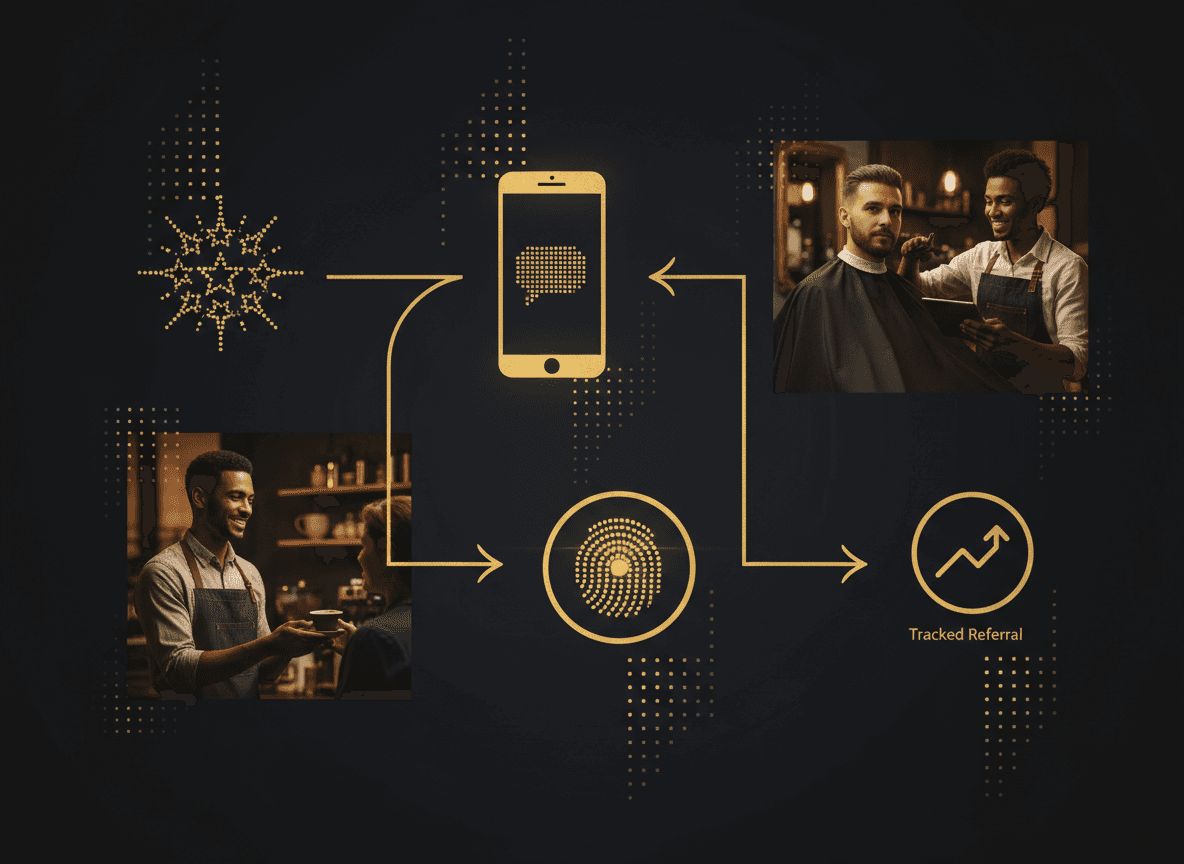
You don't ask for referrals when you remember. You ask at the moment the customer is happiest — and you let software do it.
The best trigger: right after someone leaves a 5-star review or completes a great visit. That's peak goodwill. They just told the world (or told you) they're thrilled. That is the exact second to hand them a way to send a friend.
A text goes out: "So glad you loved it, Marcus. Know someone who'd like the same? Here's your link — they get $10 off, you get $10 too."
No staff member has to remember. No awkward in-person ask. It fires every single time the trigger hits.
"Tell your friends" gives people no reason to act today and gives you no way to know if it worked.
A trackable incentive does both. Give the referrer something real — a discount, account credit, a free add-on. Give the new person something too, so the referrer isn't begging a favor, they're handing over a gift.
And track it. Every referral tied to a code or link so you know who sent whom, which offer converts, and what a referred customer is actually worth. Now it's a channel you can measure and tune — not a vibe.
This is where most attempts die. If sharing takes effort, it won't happen.
"Have them mention your name" = friction. Your customer has to remember, explain the deal, and hope it gets honored. Too many steps.
One tap. A pre-written message with their unique link they can fire into a text thread or group chat in two seconds. The easier you make the send, the more sends you get. It's that direct.
Here's the contrast that matters.

The hope model: You do great work. You cross your fingers. Referrals show up occasionally, unpredictably, and you have no idea what drives them. You can't forecast them and you can't grow them.
The installed model: Every completed visit and every 5-star review triggers an automatic ask with a trackable incentive and a one-tap link. It's wired into your booking system and your review flow so it runs whether you think about it or not.
One is a slot machine. The other is a machine.
The difference in output isn't small. When you turn a channel that fires "sometimes" into one that fires "every time," you compound. Each new referred customer becomes a future referral source inside the same loop.
Run the checklist. Right now, in your business:
If you answered "no" to any of these, your cheapest acquisition channel is leaking — and you're paying for it in flat growth.
The good news: this is fixable, and it's usually the fastest revenue lever an SMB with loyal clients has, because the goodwill already exists. You just haven't captured it yet.
Want to see exactly where your referral loop is broken — and what else is quietly costing you customers? Run your free Revenue Code Diagnostic. It maps whether your referral, booking, and review systems are actually connected or just sitting there hoping.
Stop leaving your best channel to luck. Wire it up.
Most SaaS founders treat the free trial as a waiting room. The ones converting at 25% or higher treat it as a structured sales system. Here is how to build that system.
Read moreA product roadmap tells you what you are building. A revenue engine tells you whether it is making money. Most SaaS founders only have one of these, and it is the wrong one.
Read more