Blog - The latest articles and news
Stay up-to-date with the latest industry news as our marketing teams finds new ways to re-purpose old CSS tricks articles.
Stay up-to-date with the latest industry news as our marketing teams finds new ways to re-purpose old CSS tricks articles.
by Kingdom Kode Team, Digital Innovation

You answered the phone on the first ring. You drove out same-week. You did a solid walkthrough. And then you lost the job anyway. If you want to know how to send estimates faster in home services, start here: you won the callback but lost the close.
Here's why: the homeowner got your estimate four days later as a PDF attachment — after a competitor sent a clickable, deposit-ready quote in under an hour. That's the game. Speed-to-lead gets you in the door, but the deal dies in the estimate gap.
Everyone obsesses over answering fast. Good — you should answer fast. But answering the phone is the cheap part of the funnel. The expensive leak is everything that happens after the walkthrough.

Think about a landscaping crew doing $40k/mo. They book 20 estimate appointments a week. They show up to all of them. Then they go home, and the quoting starts:
By the time that PDF lands, the homeowner already said yes to the guy who made it easy. You didn't lose on price. You lost on friction.
Speed-to-lead is how fast you respond to a new inquiry. Critical — but it only earns you the appointment. Speed-to-quote is how fast you turn that appointment into a signed, paid job. That's the half everyone ignores.
Here's an illustrative example that should keep you up at night. Say you run 20 estimates a week and close 6. Now imagine bumping your close rate from 30% to 45% just by removing friction and following up — that's 3 extra jobs a week with zero new leads. (Numbers here are illustrative, not a claimed result.) At a $2,000 average ticket, that's $24,000/mo you were already paying to generate and just... let leak out the back.
You don't have a lead problem. You have a close problem.
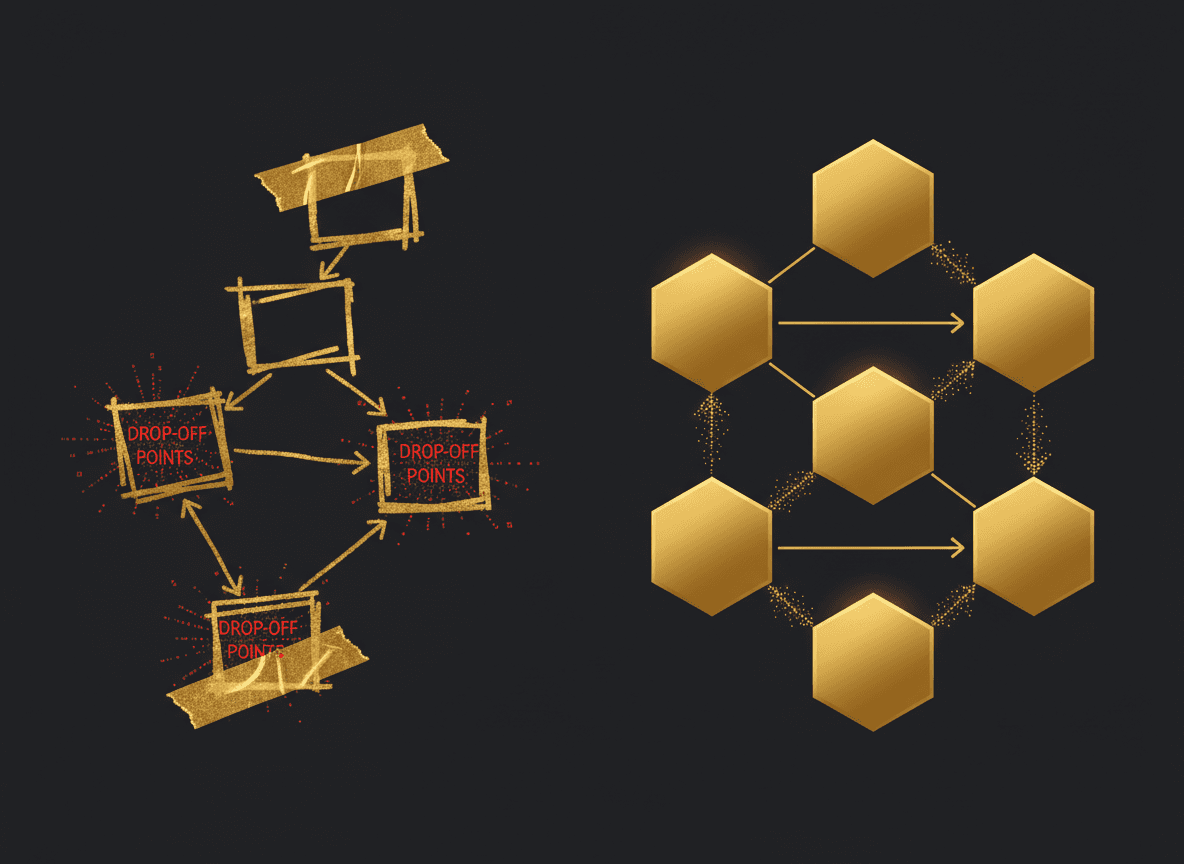
Let's put them side by side.

The duct-taped process:
Every step is a place to lose the deal. And the whole thing lives across four tools — your phone, a spreadsheet, your email, and your memory.
The integrated flow:
Same walkthrough. Same crew. Radically different close rate — because you removed every reason to say "let me think about it."
Diagnose your own process against these. You'll find at least two.
Leak 1: Manual quoting. If building an estimate takes you an hour at the kitchen table, you'll always send it late. Preset line items and templates turn an hour into five minutes — done on-site.
Leak 2: No way to accept or pay on the spot. A PDF is a dead end. The homeowner has to do work to say yes. Every extra step drops your yes rate. An estimate they can approve and put money down on with two taps closes while the excitement is still hot.
Leak 3: No follow-up. Most homeowners don't say no. They go quiet. If you're not automatically following up 3+ times, you're leaving the deals that need a nudge on the table — which is most of them.
Picture the HVAC owner doing $60k/mo. He finishes the walkthrough, opens his phone, taps the three line items for the system swap, adjusts the price, and hits send. Before he's back in the truck, the homeowner's phone buzzes with a branded estimate.
She reviews it over coffee. She taps Accept, e-signs, and pays a 30% deposit. The job drops onto next Tuesday's schedule automatically. The owner never touched a spreadsheet, never wrote a follow-up text, never chased.
That's not a bigger sales team. That's one integrated system doing the work the duct-tape can't.
The fix isn't hustling harder on the phone. It's closing the gap between "nice to meet you" and "deposit paid." Fast estimates, on-the-spot e-sign and payment, and automatic follow-up — inside one system instead of four.
Want to know exactly where your quote-to-close process is leaking money? Run your free Revenue Code Diagnostic. It maps your funnel from callback to close and shows you the biggest leak first — no pitch required.
If you'd rather talk it through, Book a pricing call or read more breakdowns on the blog.
Most SaaS founders treat the free trial as a waiting room. The ones converting at 25% or higher treat it as a structured sales system. Here is how to build that system.
Read moreA product roadmap tells you what you are building. A revenue engine tells you whether it is making money. Most SaaS founders only have one of these, and it is the wrong one.
Read more