Blog - The latest articles and news
Stay up-to-date with the latest industry news as our marketing teams finds new ways to re-purpose old CSS tricks articles.
Stay up-to-date with the latest industry news as our marketing teams finds new ways to re-purpose old CSS tricks articles.
by Kingdom Kode Team, Digital Innovation

You spent money getting patients to book. Recall campaigns, ads, referrals. The calendar is full.
Then they show up to a clipboard, a pen on a chain, and a front-desk person juggling three phone lines while typing a new patient's insurance info by hand.
That's the bottleneck. And online patient intake forms for clinics are the cheapest fix most owners ignore because it feels like a "nice to have." It isn't. Your front desk is either a revenue engine or a leak. Right now it's probably a leak.
Let's name the four leaks, because you can't fix what you can't see.

1. No-shows and late cancellations. A patient who has to fill out 15 minutes of paperwork before their appointment even starts is a patient who's less committed and more likely to bail. Friction at the door raises the odds they don't walk through it.
2. Data errors. Handwritten insurance numbers get transposed. A single wrong digit means a denied claim, a re-bill, and a phone call three weeks later. Multiply by every new patient.
3. Staff overwhelm. Your front desk person can either build rapport with the patient in front of them or manually re-key a clipboard into your PMS. They can't do both. So one of those suffers — usually the patient experience.
4. The waiting-room backup. Paper intake happens after arrival. So the first appointment of the day runs late, and every slot after it inherits the delay. By 2pm you're 20 minutes behind and everyone's stressed.
None of these show up as a line item. That's why they never get fixed. They just quietly cost you rebooked chairs and burned-out staff.
The fix isn't "add a form to your website." A form nobody fills out is worse than paper. The fix is tying intake to your booking flow so it happens automatically, before arrival.
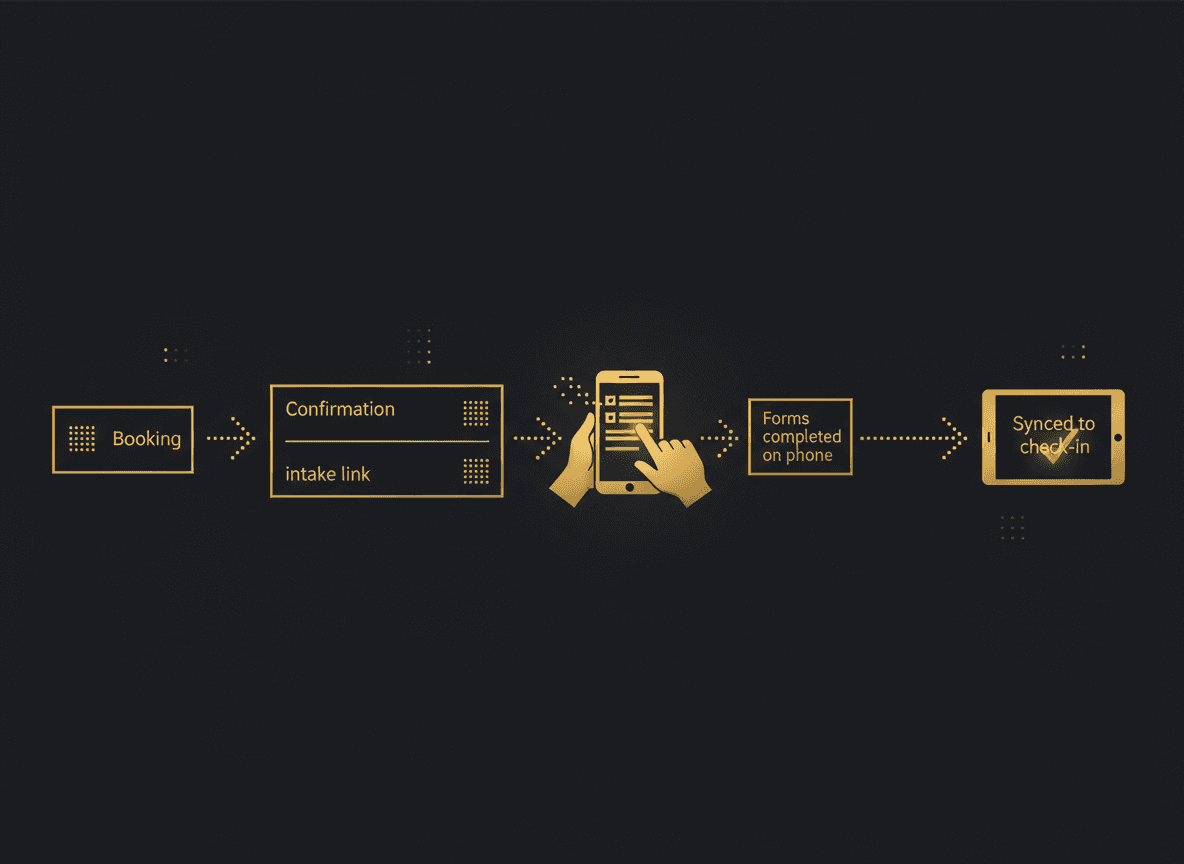
Here's the sequence that works:
That's the whole model. Send on confirmation → complete before arrival → sync to check-in. Everything else is detail.
Take a clinic with 12 new patients a week. Say paper intake plus manual entry eats 12 minutes of staff time per patient — the filling out, the chasing, the typing, the fixing errors.

That's 144 minutes a week. Nearly two and a half hours of a paid employee doing data entry that software does for free. Over a year, that's more than 120 hours — most of a full work-month — spent on a task that should be invisible.
Now add the no-show reduction from lower friction and the denied claims you stop eating from typos. The form isn't a cost. It pays for itself in reclaimed payroll alone, before you count the revenue it protects.
Stop thinking of the front desk as "the people who answer the phone." That's the old frame, and it's why the function gets neglected.
The front desk controls three things that move money: whether patients show up, whether their appointment starts on time, and whether they leave feeling handled well enough to come back and refer. Digital intake improves all three at once.
When intake is handled before arrival, your staff stops being data-entry clerks and starts being the reason patients choose you over the clinic down the street. That's a better use of the people you're already paying.
The clinics that win here aren't the ones with the fanciest software. They're the ones who connected booking, intake, and check-in into one flow so nothing gets typed twice and nobody waits.
Before you buy a single tool, figure out where your front desk is actually bleeding — no-shows, data errors, or staff time. Fixing the wrong one wastes money.
That's exactly what the diagnostic is for. Run your free Revenue Code Diagnostic — it pinpoints where your intake and booking flow leaks money and what to fix first.
Want us to build the send-on-confirmation intake system for you? Book a pricing call. Or read more front-desk breakdowns on the blog.
Most SaaS founders treat the free trial as a waiting room. The ones converting at 25% or higher treat it as a structured sales system. Here is how to build that system.
Read moreA product roadmap tells you what you are building. A revenue engine tells you whether it is making money. Most SaaS founders only have one of these, and it is the wrong one.
Read more