Blog - The latest articles and news
Stay up-to-date with the latest industry news as our marketing teams finds new ways to re-purpose old CSS tricks articles.
Stay up-to-date with the latest industry news as our marketing teams finds new ways to re-purpose old CSS tricks articles.
by Kingdom Kode Team, Digital Innovation

You have a list. Hundreds, maybe thousands of people who paid you once and vanished. You never text them. You never email them either — or you do, and it disappears into a promotions tab nobody opens. That list is money, and text message marketing for small business is the fastest way to turn it back into booked appointments.
Here's the uncomfortable math: a client who came in every 6 weeks and stopped is worth hundreds — sometimes thousands — over the next year. You already paid to acquire them. Winning them back costs you a 160-character message. Yet most owners do nothing, because they don't have a system that makes doing something easy.
Email open rates hover in the teens to low twenties. Texts get opened far more often, and usually within minutes. That's not a small edge. That's the difference between a message that gets read and a message that never happened.
Think about your own phone. You ignore emails for days. You read texts at a red light. Your customers are exactly the same.
For a business that runs on appointments, speed is the whole game. A chair open at 2pm today is worth nothing at 2:01. Email can't fill it. A text can.
Text message marketing for small business isn't about blasting coupons. It's about putting the right message in front of the right person at the moment they can act on it.
You don't need 20 campaigns. You need three, running on autopilot.
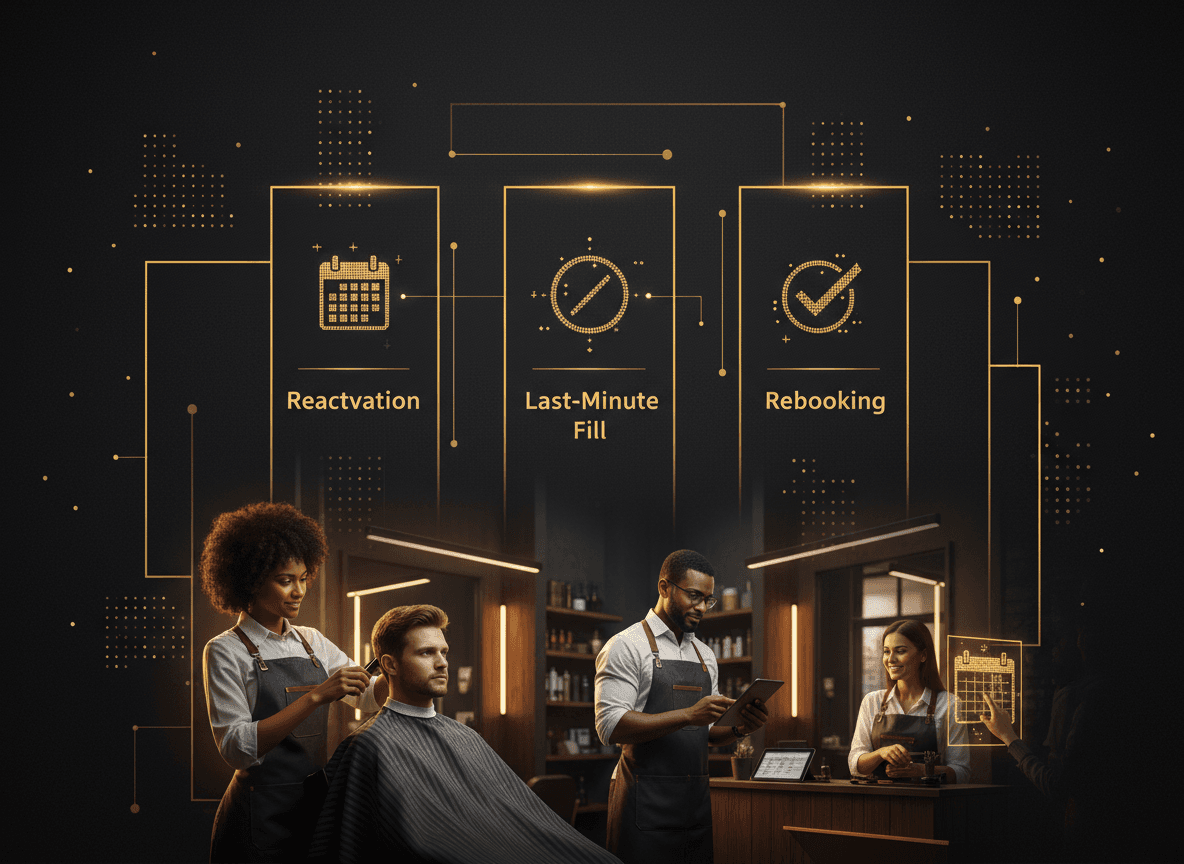
1. Reactivation. Pull everyone who hasn't booked in 60, 90, or 120 days. Send one message: "Hey [name], it's been a while — we've got openings this week and saved your usual slot. Want it?" That's it. Picture a hypothetical barbershop doing $30k/mo with 800 lapsed clients: even a modest reply rate on a single well-timed send could refill a meaningful number of chairs. Run that math on your own list and it usually stings.
2. Last-minute fill. A cancellation at 10am creates a hole at 1pm. Instead of eating the loss, an automated text goes to a short list of nearby, flexible clients: "Opening today at 1pm — first to reply gets it." The hole closes in minutes.
3. Rebooking. The best time to book the next visit is right after the current one. An automated text 24 hours after an appointment — "Ready to lock in your next one?" with a booking link — turns a one-time visit into a rhythm.
Notice what these have in common: they're all triggered by data you already have. Last visit date. Appointment status. Booking history. The system does the thinking. You just collect the revenue.
Plenty of owners "do texting." They mean they thumb-type messages from their personal cell between customers.
That doesn't scale, and it's blind. You can't:
An integrated system ties your texts to your booking software. Someone lapses — a message fires. Someone cancels — the fill list activates. Someone visits — the rebooking sequence starts. You see exactly which messages drove which bookings and which dollars.
The difference between DIY texting and an integrated system is the difference between a side hobby and a channel that quietly runs in the background making you money.
Here's where owners freeze: TCPA, opt-in, "am I allowed to text people?"
The rules are simpler than the fear. You need consent to send marketing texts, and you need to honor opt-outs. That's the core of it.
The good news: a real system handles this for you. Opt-in gets captured at booking or checkout. Every message includes a way to opt out. Unsubscribes are processed automatically so you never text someone who said stop. Consent is logged, so you're covered.
Compliance isn't a reason to avoid text marketing. It's a reason to avoid doing it manually from your personal phone with no records. The system removes the risk, not adds to it.
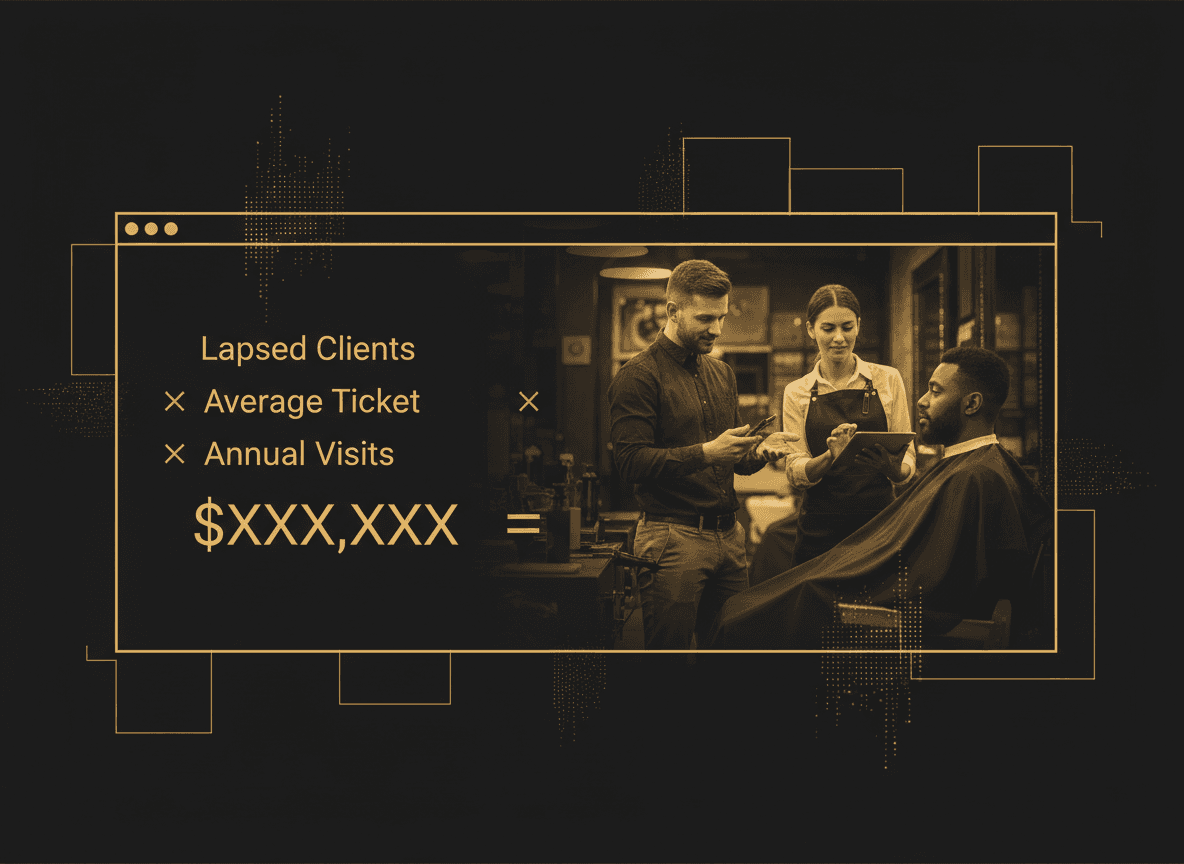
Run the numbers on yourself. Take your lapsed client count. Multiply by your average ticket. Multiply by how many times a reactivated client would return in a year.
That number is usually big enough to sting — because it's money you've already earned the right to and are simply leaving on the table.
Most owners have never calculated it. That's the whole problem. You can't fix a leak you can't see.
The channel is proven. The plays are simple. The only question is how much dormant revenue is sitting in your list right now — and what a system to recapture it is worth to you.
That's exactly what our free diagnostic surfaces. Run your free Revenue Code Diagnostic and see the number for your business. No pitch, just the math.
Want more breakdowns like this? Read the rest of the blog, or book a pricing call if you're ready to build it.
Most SaaS founders treat the free trial as a waiting room. The ones converting at 25% or higher treat it as a structured sales system. Here is how to build that system.
Read moreA product roadmap tells you what you are building. A revenue engine tells you whether it is making money. Most SaaS founders only have one of these, and it is the wrong one.
Read more