Blog - The latest articles and news
Stay up-to-date with the latest industry news as our marketing teams finds new ways to re-purpose old CSS tricks articles.
Stay up-to-date with the latest industry news as our marketing teams finds new ways to re-purpose old CSS tricks articles.
by Kingdom Kode Team, Digital Innovation

Your next customer isn't typing into Google. They're asking ChatGPT "who's the best {your service} near me" — and getting a short list of three names. Whether you make that list increasingly comes down to one small file most owners have never heard of: llms.txt.
If you're not on that list, you don't exist. No second page to fight your way onto. No ads to buy your way in. Just three answers, and you're not one of them.
So let's answer the question you came here for: what is llms.txt and do I need one? Short version: it's a small text file that tells AI models what your business is, what you do, and which pages matter — and yes, if customers in your market are starting to search with AI, you want one.
llms.txt is a plain-text file that lives at the root of your website (yoursite.com/llms.txt). Think of it as a menu you hand directly to AI models like ChatGPT, Claude, and Perplexity.

Here's the problem it solves. Your website was built for humans and for Google's crawler. It's full of navigation menus, cookie banners, popups, and marketing fluff. When an AI tries to read it, it has to guess what actually matters. Guessing means mistakes. Mistakes mean it skips you.
llms.txt cuts the guessing. It's a clean, structured summary written in Markdown: who you are, what you offer, your key pages, your service area, your hours. No clutter. The model reads it in seconds and knows exactly how to describe you.
You'll also hear people say llm.txt — same idea, and some sites use both. Don't get stuck on the name. The point is a machine-readable file that speaks the AI's language instead of making it dig.
Do you need one? Ask yourself: are your customers the kind of people who'd ask an AI for a recommendation before they call? For a local barbershop, maybe that shift is early. For a B2B software consultant, an accountant, a marketing agency, a med spa — it's already happening. If the answer is "yes, some of them," you're behind the moment a competitor sets theirs up.
A good llms.txt does three jobs.
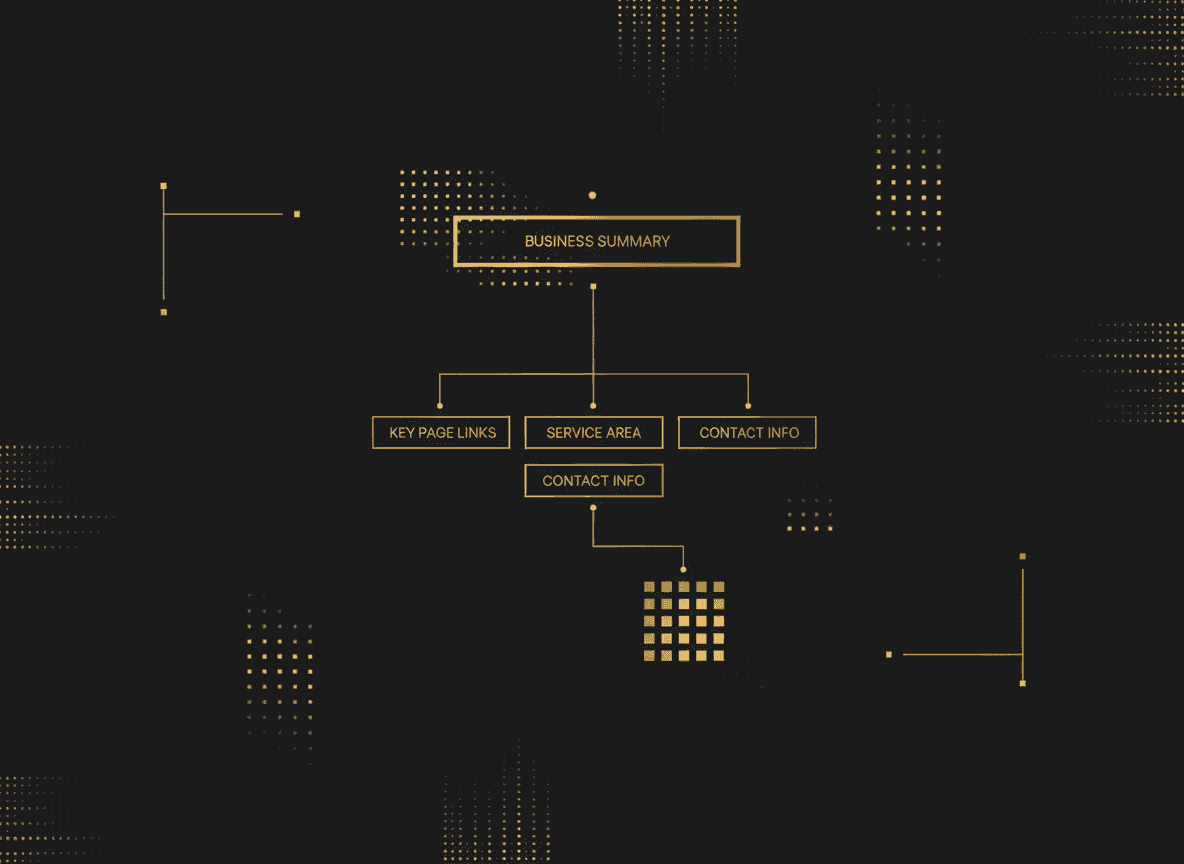
1. It defines you. One clear sentence the AI can repeat: "Kingdom Kode builds revenue systems for small businesses — websites, booking, automation, and AI-readiness." When someone asks, the model has your description ready instead of inventing one.
2. It points to the pages that matter. You list your key URLs with a short note on each — your services page, pricing, contact, best articles. The model knows where to send people and what to cite.
3. It removes ambiguity. Service area, specialties, what you don't do. This keeps the AI from recommending you for the wrong thing — or worse, recommending you and getting the details wrong.
Models don't reward effort. They reward clarity. A business that spells out exactly what it does gets described accurately and confidently. A business that makes the model guess gets skipped in favor of one that didn't.
Here's how it plays out across three levels.

No file at all. The AI scrapes your homepage, hits a wall of design and marketing copy, and pulls a vague, half-wrong summary — or nothing. When a user asks for a recommendation in your category, you're not in the shortlist. You never see it happen. There's no analytics dashboard telling you how many referrals you lost to ChatGPT this month. It's silent.
File done, but done lazily. A stub file with your name and a tagline. Better than nothing, but the model still can't tell what you specialize in or where to send people. You show up occasionally, described generically.
File done well. Clear positioning, key pages mapped, specialties spelled out, kept current. When someone in your market asks an AI for help, you're a name it can recommend with confidence — because you made it easy.
The gap between the first business and the third isn't talent or budget. It's a file most owners have never heard of. That's the whole opportunity: this is early. The competitor who moves first in your market gets recommended by default while everyone else waits.
Here's what most people miss. llms.txt tells the AI what to read. Schema and structured data tell it how to trust and use what it read.
Schema is code behind your pages that labels information in a way machines understand: this is a price, this is a review, this is a business address, these are your hours, this is a FAQ. It's the same structured data that powers Google's rich results — and AI models lean on it to verify and present your details.
Stack them together and you get AI-readiness:
One without the others is a car with three wheels. A great llms.txt pointing at pages with no schema still leaves the model unsure. Perfect schema with no llms.txt still makes the model dig through clutter. You want the full stack.
Run this quick self-check:
If any of those come back weak, you have a visibility gap that's costing you customers you'll never even know you missed.
The fix isn't hard, but it has to be done right — the file has to be accurate, the schema has to be clean, and everything has to point the same direction. A sloppy version can do more harm than none.
We map exactly where you stand — AI-readiness, schema, and the rest of your revenue system — in a free diagnostic. It shows you the specific gaps before you spend a dollar fixing them.
Run your free Revenue Code Diagnostic and see whether AI is recommending you or your competitor. Want to talk it through first? Reach out or read more on the blog.
Most SaaS founders treat the free trial as a waiting room. The ones converting at 25% or higher treat it as a structured sales system. Here is how to build that system.
Read moreA product roadmap tells you what you are building. A revenue engine tells you whether it is making money. Most SaaS founders only have one of these, and it is the wrong one.
Read more