Blog - The latest articles and news
Stay up-to-date with the latest industry news as our marketing teams finds new ways to re-purpose old CSS tricks articles.
Stay up-to-date with the latest industry news as our marketing teams finds new ways to re-purpose old CSS tricks articles.
by Kingdom Kode Team, Digital Innovation

Here's a question that decides whether your business is an asset or a hostage: who owns my customer data? If you're a small business owner running on a booking app, a delivery platform, and a couple of social profiles, the honest answer is usually "not you."

You think those 2,000 past customers are yours. They're not. They live inside someone else's database, behind someone else's terms of service, reachable only when that platform decides to let you reach them. You're renting access to people you already earned.
That's the vendor lock-in tax. And most owners never see the bill until it's too big to ignore.
Every tool that sits between you and your customer takes a cut — in money, in access, or in both.
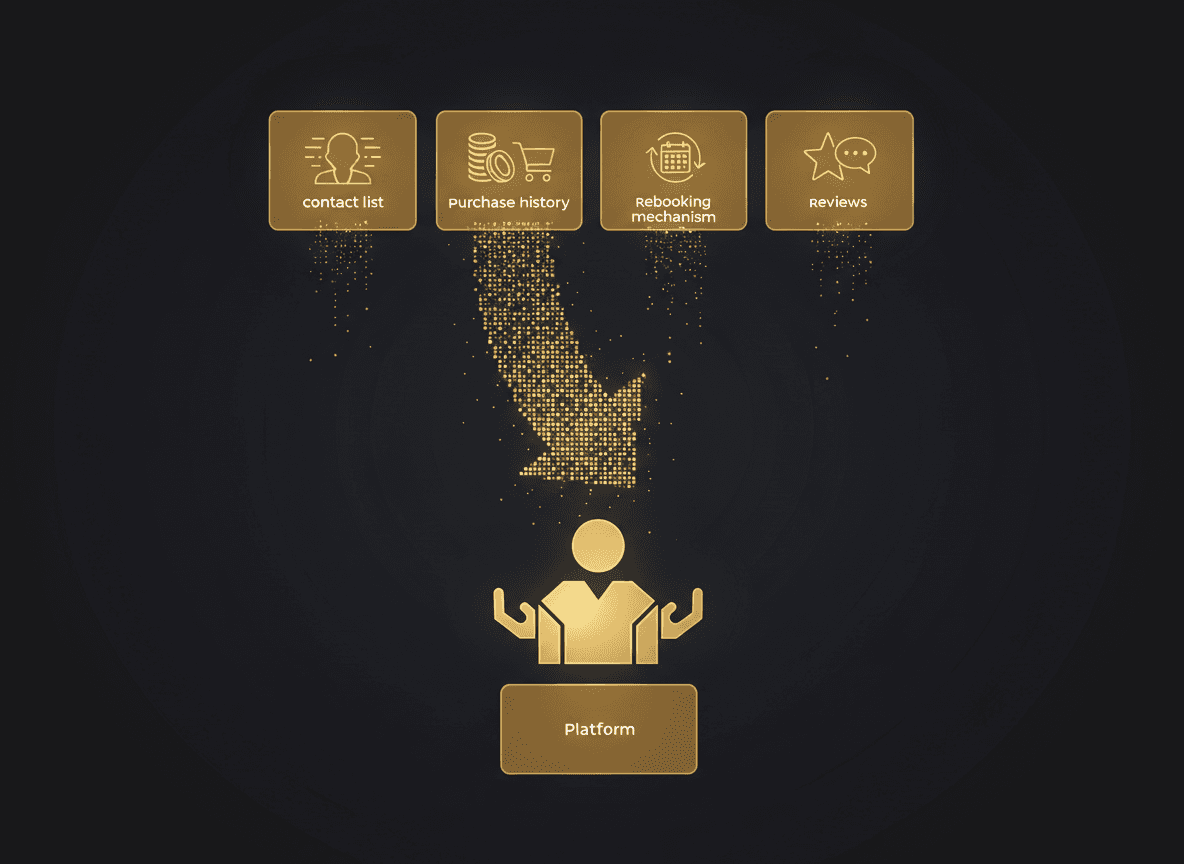
None of this is free. You pay in fees today and in leverage tomorrow.
When a third party sits in the middle, they accumulate the four assets that actually run your revenue:

Lose access to these and you don't lose a tool. You lose the business.
This is not hypothetical. Platforms do three things, reliably, once you depend on them:
They raise fees. A barbershop paying 2% on bookings wakes up to 5%. On $30k/mo, that's $900 a month you now pay for the same service you used to get cheaper.
They insert themselves deeper. "Featured" placement. "Promoted" slots. Suddenly you're paying to reach customers who already chose you.
They pull the plug. Account suspended for a policy you didn't know existed. Access frozen during a dispute. The platform shuts down or gets acquired. Your "list" evaporates and there's no export button.
When any of these hit, an owner with no owned database has zero moves. An owner with a direct line to their customers just sends an email and keeps the lights on.
Ownership isn't complicated. It's just deliberate. You want three things under your own roof:
A booking system you control. Bookings still happen, but the customer data flows into a database you own — not one you rent. You keep using platforms for discovery. You just stop letting them keep the relationship.
A customer database that's yours. Every person who books, buys, or inquires lands in one place you export any time: name, contact, history. This is the asset a buyer pays for if you ever sell.
Direct-contact channels. Email and SMS you send from your own systems. When you want to fill Tuesday afternoons, you don't beg an algorithm — you message the 400 people who already love you.
The platforms become what they should be: a top-of-funnel channel for new customers, not the landlord of your entire customer base.
Before you fix anything, measure the leak. Sit down and answer these:
Write the answers down. The gaps you just found are the vendor lock-in tax, quantified. That's the exact problem worth solving before it solves you.
You spent years and real money earning every customer you have. Letting a third party hold them hostage is the most expensive mistake most owners never notice — until fees rise or the plug gets pulled.
The fix is to own the booking, the database, and the direct line. That's what turns your customer list from a login you can lose into an asset you control.
Want to know exactly where your revenue is hostage right now? Run your free Revenue Code Diagnostic — it maps where you're leaking leverage to third parties and what it's costing you every month. Read more breakdowns like this on the blog, or book a pricing call when you're ready to take your customers back.
Most SaaS founders treat the free trial as a waiting room. The ones converting at 25% or higher treat it as a structured sales system. Here is how to build that system.
Read moreA product roadmap tells you what you are building. A revenue engine tells you whether it is making money. Most SaaS founders only have one of these, and it is the wrong one.
Read more